Mining, Shaping, Visualizing, and Interpreting Instagram Hypertextual Networks of Freight Train Graffiti Communalities in North America Using Machine Learning Custom Models and Graphology
📊 Live Dataset Dashboard
Explore mined tasks, node counts, and live Graphology visualizations.
View Tasks (/hashtags)The practice of benching in graffiti has evolved over time, transitioning from a gathering point for graffiti writers in New York City subway stations, where they admired and valued the artwork on passenger vehicles, to becoming an integral part of graffiti on freight trains in North America. Nowadays, interventions decorating rolling stock that circulates transnationally are documented and shared in benching communities. Although the dynamics and geographical reach have shifted from hyper-local to international through online platforms, the underlying principle remains the same: benching serves as a meeting place where writers appreciate each other’s work and gain recognition.
This methodological-practical study explores the possibilities of analyzing communalities among graffiti writers on freight trains through their online publications. Communalities can be derived from data such as the types of documented graffiti, the number of likes, the quantity of comments, the communal glossary used in hypertextual tags, and the volume of posts published inside those hashtags.
This text revolves around the exposure of three hypertextual conversations with different mining scales and analyzing scopes. It showcases the hashtags of a graffiti writer in freight trains (#kosm), a communal meeting point hashtag (#freightgraffiti), and a geographically focused hashtag (#portlandbench). By selecting the seed node in the mining iterator, different types of symbolic exchanges, participants, and content within Instagram metadata and those generated through training and inference of machine learning models can be analyzed.
While the interpretation of these three examples is central, the text also presents the encoded computational techniques for data extraction, construction, and visualization of user-generated conversations on Instagram. Parameters such as depth, the number of mined posts, and the concept of seed node in data mining are discussed. The text addresses the limitations and capabilities of the machine learning models used, including object detection in images and categorization of hypertextual tags in posts. Additionally, it highlights data cleansing and parameters such as gravity, scale-ratio, and centrality measures used for real-time visualization achieved through Graphology.
1. Introduction
Benching is a central practice in contemporary graffiti culture, with its roots tracing back to the subway stations of New York City during the golden era of subway graffiti. At these iconic benching spots such as GrandConcourse and 149st, graffiti writers would gather to observe, appreciate, and peer-review graffiti. These spots worked not only as observation points but also as social hubs where writers could engage with one another, exchange techniques, and earn recognition within their specific community of practice.
With the emergence and consolidation of user-generated content platforms like Instagram, the tradition of benching undergoes a transformation, adapting to new mediums. Hashtags such as #FreightBenching facilitate this transition, turning local benching spots into digital communities of practice. Here, graffiti writers and benchers gather to share evidence of active and live geographically dispersed graffiti scenes. This shift not only expands the reach of different graffiti writers' self-promotion but also creates a transnational peer-to-peer community, while still preserving the core principle of graffiti culture: the competitive getting up (Castleman, 1980).
This paper aims to demonstrate the application of computational social science methods in visualizing and analyzing three hypertextual conversations with different mining scales and analytical scopes. Specifically, it explores the autopromotion of a freight graffiti writer using the hashtag #kosm, as well as the communal retransmission of graffiti interventions in two distinct spaces: the general meeting point hashtag #freightgraffiti and a geographically focused one, #portlandbench. Through these examples, the paper discusses the computational techniques employed in studying digital graffiti communities on Instagram.
2. Mine and Inference #freightgraffiti
Graffiti on freight trains in the North American region can be studied from various perspectives: from the expansion of transnational circulation circuits and the consolidation of a long-distance messaging system to the curating processes through the analysis of local and international specialized magazines, and the symbolic production of graffiti writers involved in this community of practice.
Physically, graffiti on freight trains has a particular spread dynamic. Writers mark the sides of freight vehicles in “yards,” railway tracks used as garages, located on the outskirts of cities or rural areas where rail vehicles may wait for days or months before embarking on their journeys, which can be local, national, or transnational. It is in distant latitudes where other writers or benchers watch, evaluate, and document these interventions, forming a transnational circuit of New York tradition graffiti, both physical and digital.
However, in the socio-digital dimension, particularly in Instagram posts as materiality, several analyzable elements come together. Instagram is a user-generated content platform where content is organized using hypertextual tags (or hashtags). A graffiti writer may tag a photograph of their recently completed piece with their name #kosm and a community hashtag like #freightgraffiti with the intention of having other writers or graffiti enthusiasts view it. Benchers, on the other hand, primarily document interventions and may tag the writer #mecrograffiti, the location #portlandbenching where they documented the railway vehicle, and a communal tag like #fr8porn. Together, these practices generate networks of symbolic exchange, which through self-promotion by writers and retransmission by benchers, allow us to approach this phenomenon with symbolic elements, geographical references, and writer/crew entities that participants in this community of practice share and value collectively, driven by a core practice in contemporary graffiti: getting up (Castleman, 1980).
2.1 Data Collection Processes & idmb Bot
📦 GitHub Repo: idmb 🔗The Data Collection Processes detailed herein delineate the systematic approach undertaken by the Instagram Data Mining Bot (idmb 🔗) to extract and process data from Instagram's extensive user-generated data repository.
🤖 2.1.1 idmb: A Harmless Mining Bot
Interacts with Instagram's API via the open-source Instagrapi library (AdW0rd, 2022). Backs up user information (ID, username, follower counts), media content (images/videos), captions, and engagement metrics (likes, comments).
🌱 2.1.2 Seed Node & 2.1.3 Hashtag Iterator
The seed node serves as the focal point for initiating collection (e.g. #freightgraffiti). The hashtag_iterator() recursively traverses top-liked posts and associated hashtags up to the specified mining depth.
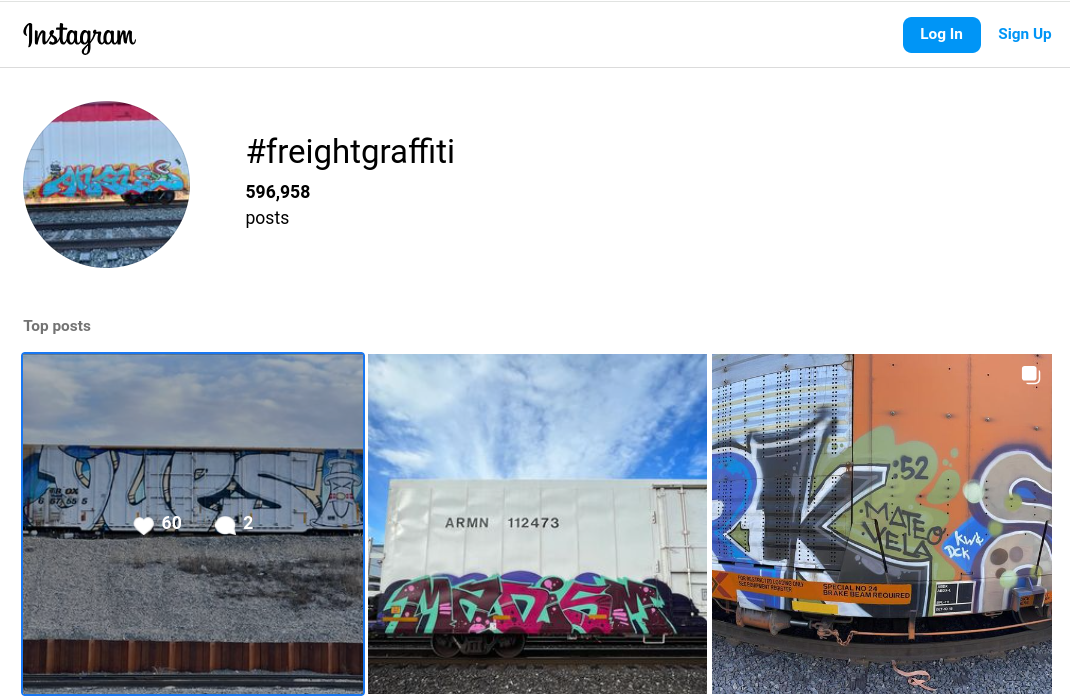
Instagram #FreightGraffiti screenshot showing seed node exploration and post metadata mined by `idmb`.
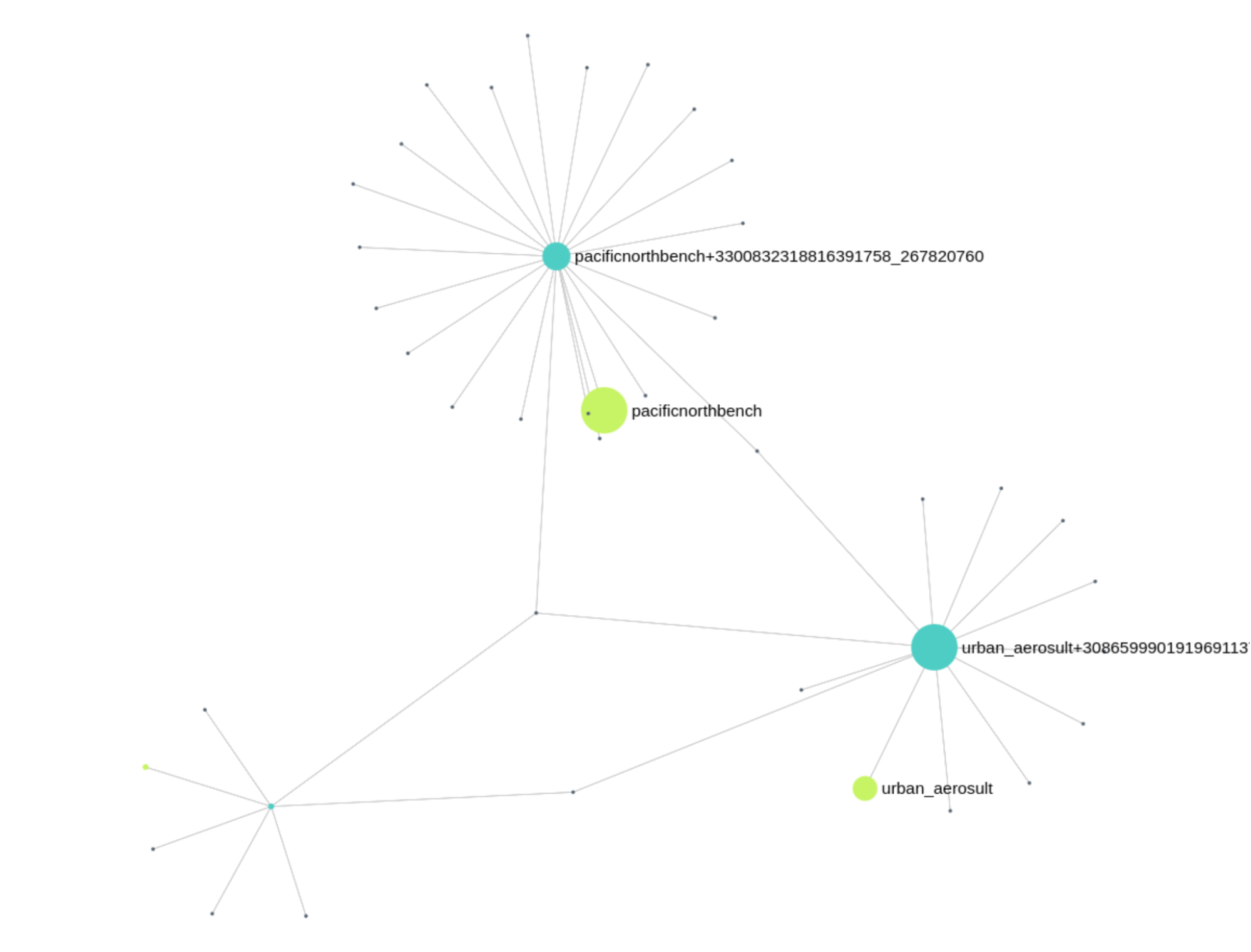
Graph of #freightgraffiti seed node at 0 mining depth downloading 3 top posts for each hashtag.
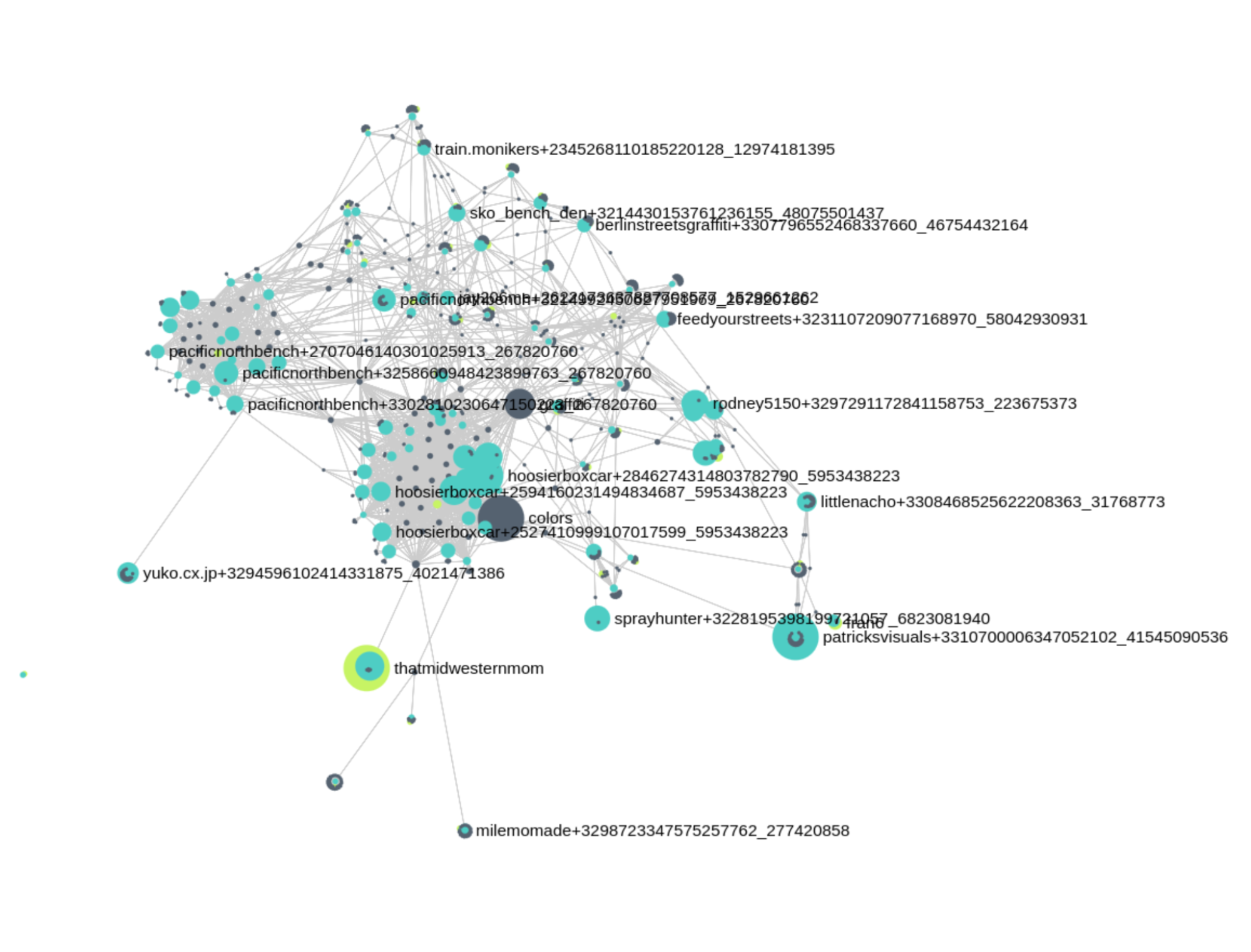
Graph of #freightgraffiti with 1 mining depth showing network expansion across hashtags.
2.2 Application of Machine Learning Techniques (TensorFlow)
📦 GitHub Repo: Graffiti_Detection_OD_TensorFlow 🔗This work employs TensorFlow (Abadi, 2015) and spaCy (Honnibal, 2020) to infer significant symbolic content in Instagram posts. Object detection models categorize visual graffiti styles, connecting these inferences back to post and user nodes.
🎯 2.2.1 TensorFlow Object Detection (ResNet Architecture)
Trained on a dataset of 1,592 images manually labeled using LabelImg across 8 distinct categories:
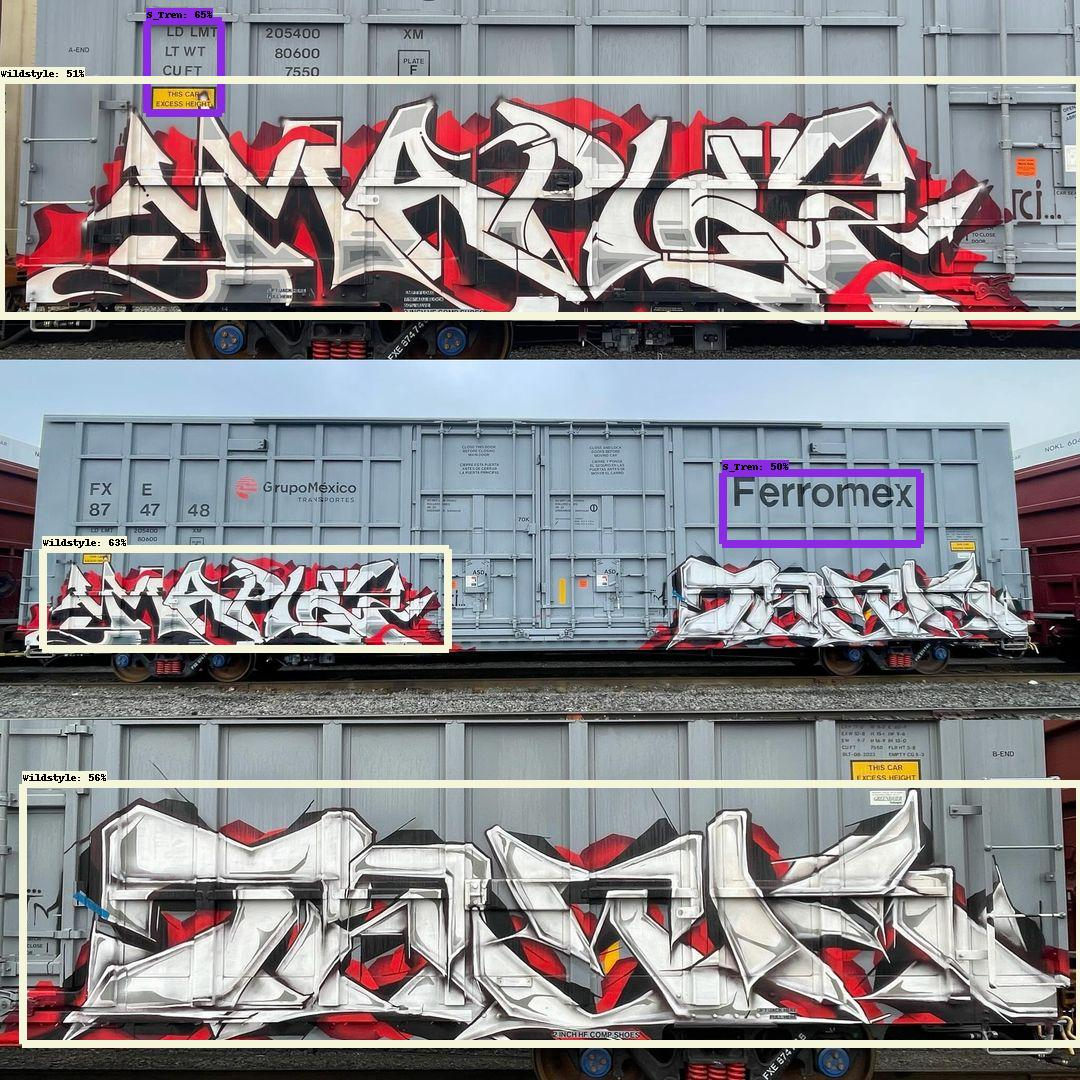
Image processed with TensorFlow custom model identifying Wildstyle graffiti and “Ferromex” train identifier bounding boxes.
2.3 Natural Language Processing (NLP) Analysis (spaCy)
📦 GitHub Repo: Hashtag_Custom_NER_spaCy 🔗Deconstructing complex hashtags (e.g. #FreightTrainGraffiti) using custom spaCy functions:
- 2.3.1 Hashtag Splitter (
parsetag&findword): Strips the#character and segments concatenated tokens (e.g.#BoxcarArtGraffiti→ Boxcar, Art, Graffiti) against comprehensive English and Spanish wordlists. - 2.3.2 Graffiti Entity Recognition (
graffitientitieslookup& OoV): Identifies writer names and crew acronyms. Out-of-Vocabulary (OoV) heuristic classifies 2–4 character strings as crews and 5–8 character strings as writers.
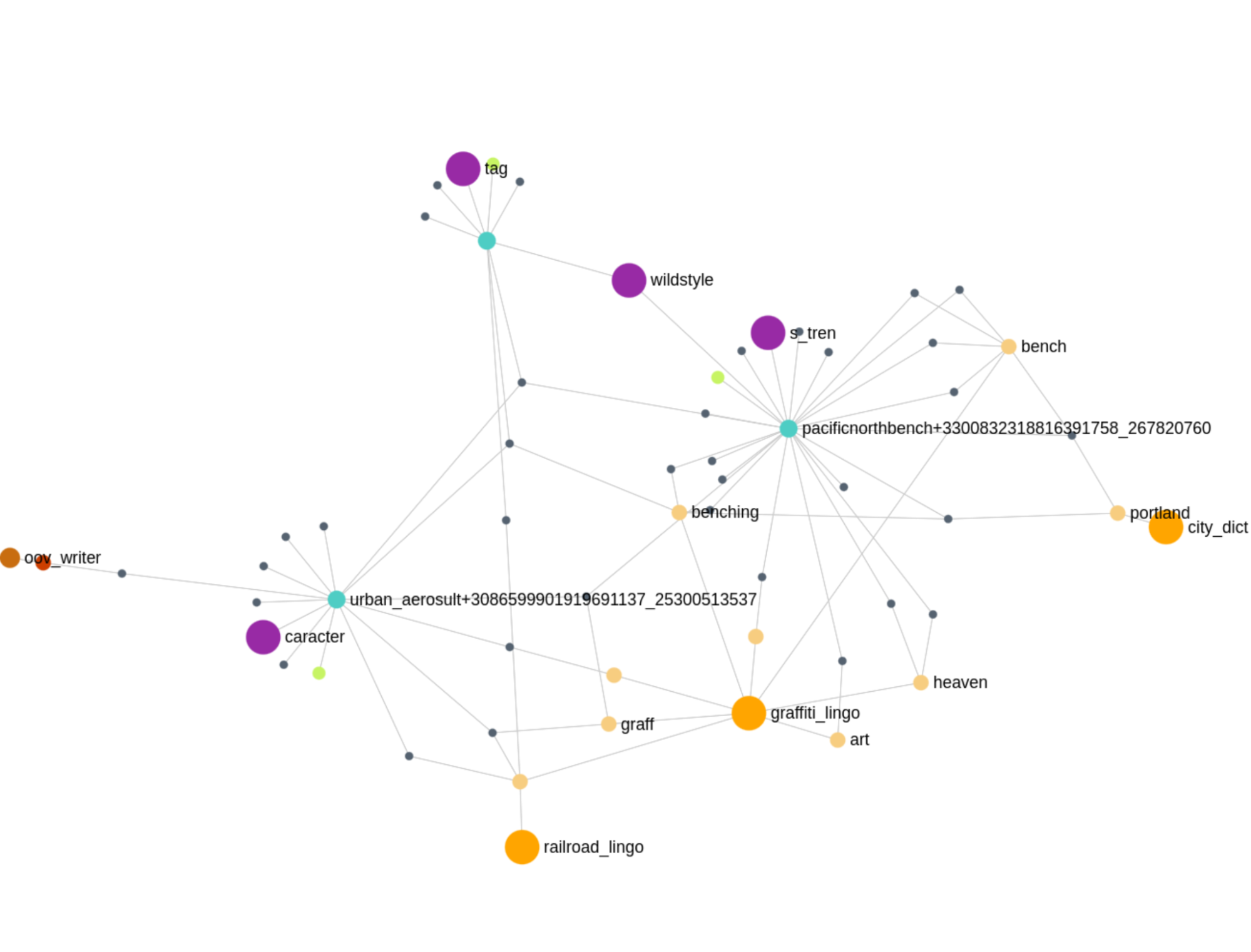
Example #freightgraffiti graph with image classification and spaCy text inferences linked to hashtag/post nodes.
3. Modeling and Interpretation of Hypertextual Conversations
Network graphs are generated from relational text databases using Graphology syntax (Plique, 2021). Node sizes reflect centrality metrics or Louvain community membership, while spatial positions are calculated via ForceAtlas2 layout algorithms.
3.1 Network Structure Layout & JSON Schemas
The network structure is composed of three core node types: Users, Posts, and Hashtags, linked as User → Post → Hashtag, alongside inferential Machine Learning nodes:
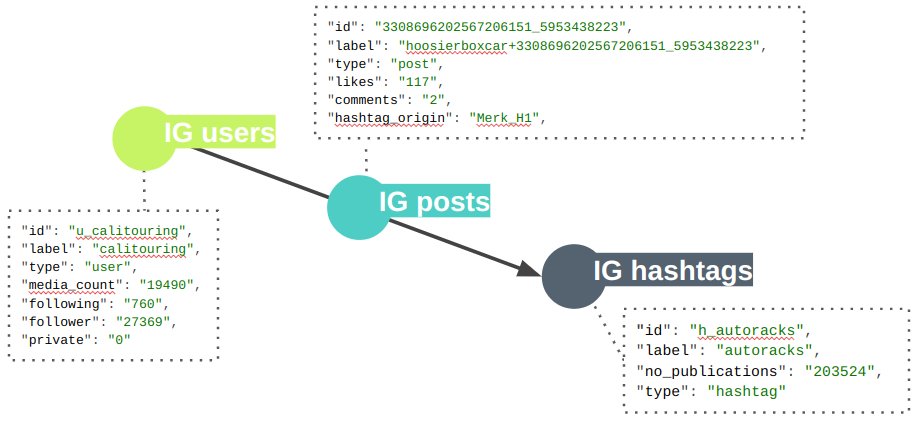
Basic graph morphology with mined attributes (IG Users → IG Posts → IG Hashtags).
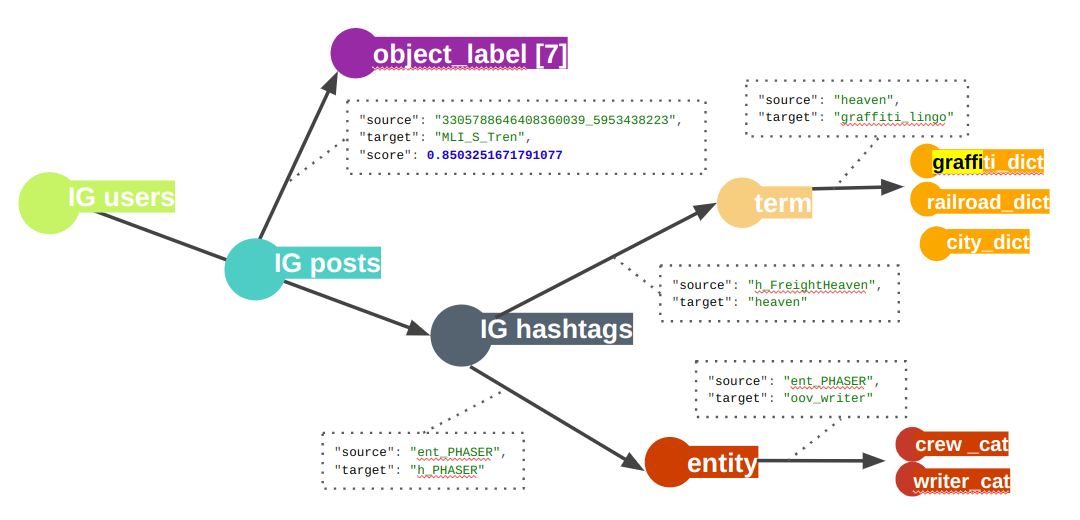
Inference graph morphology showing edge direction for ML object labels, dictionaries, and entities.
3.2 Clustering & Polysemic Divergence
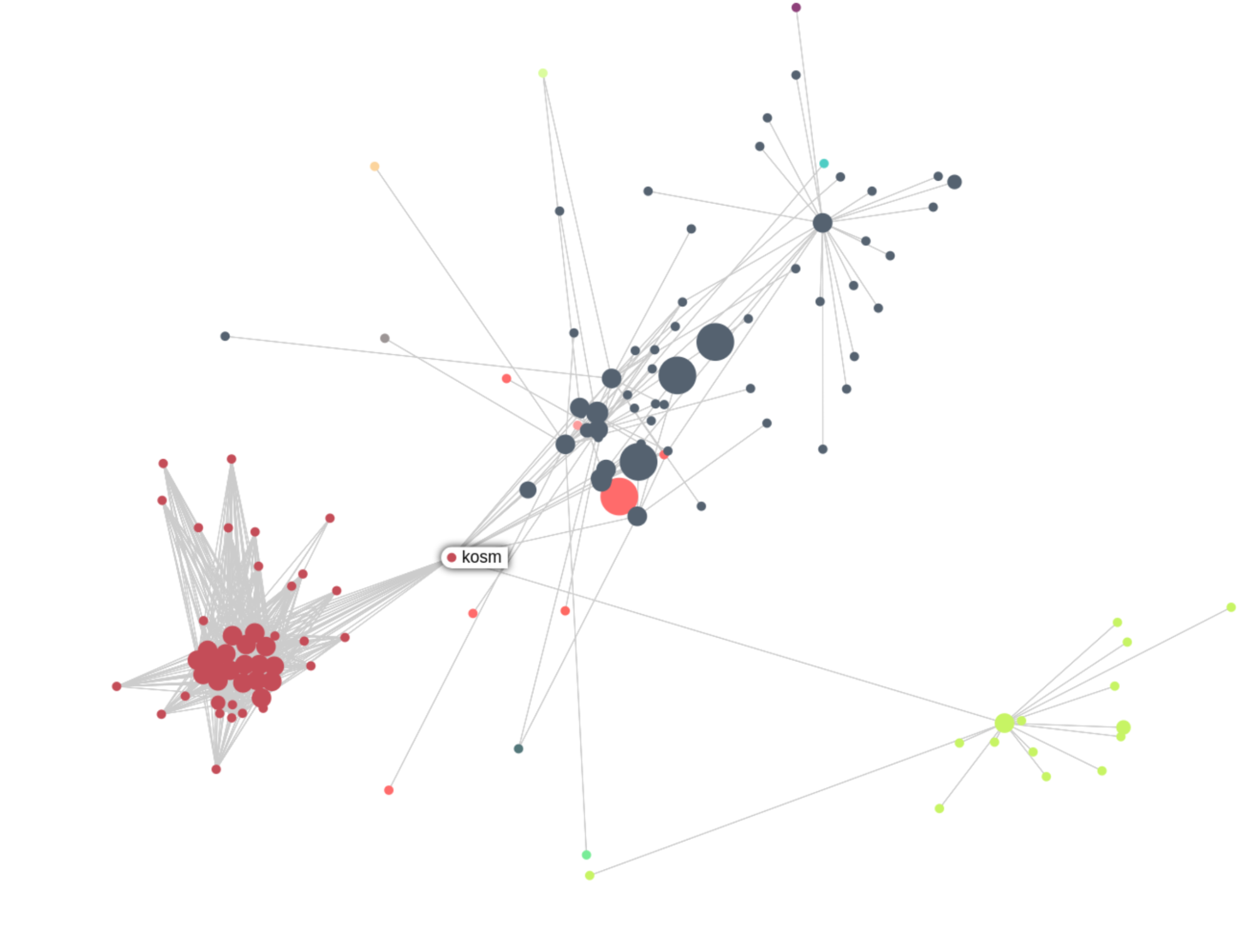
Hypertextual conversations frequently suffer from polysemy. For instance, the hashtag #Kosm (a renowned Mexican freight graffiti writer) produces three distinct Louvain clusters:
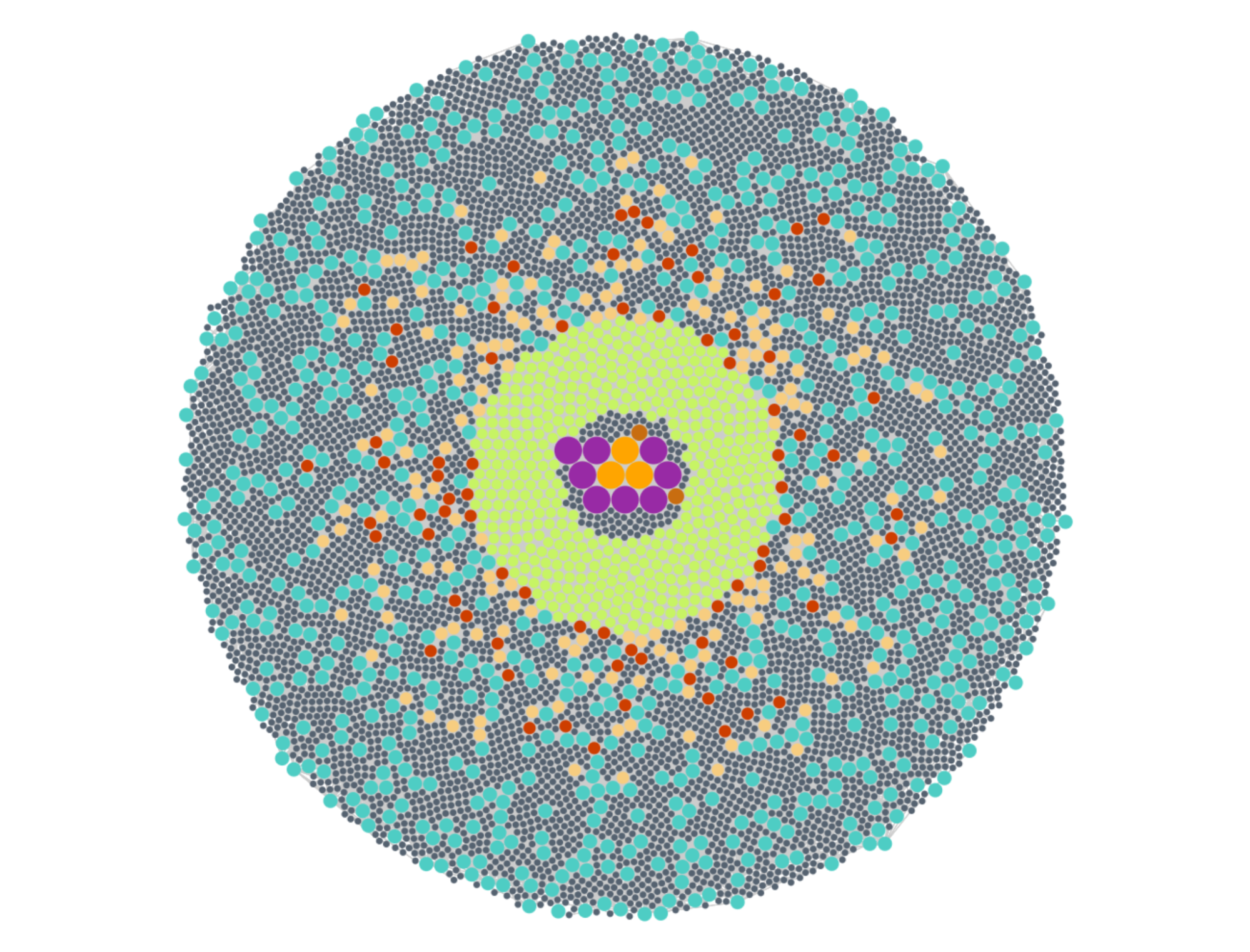
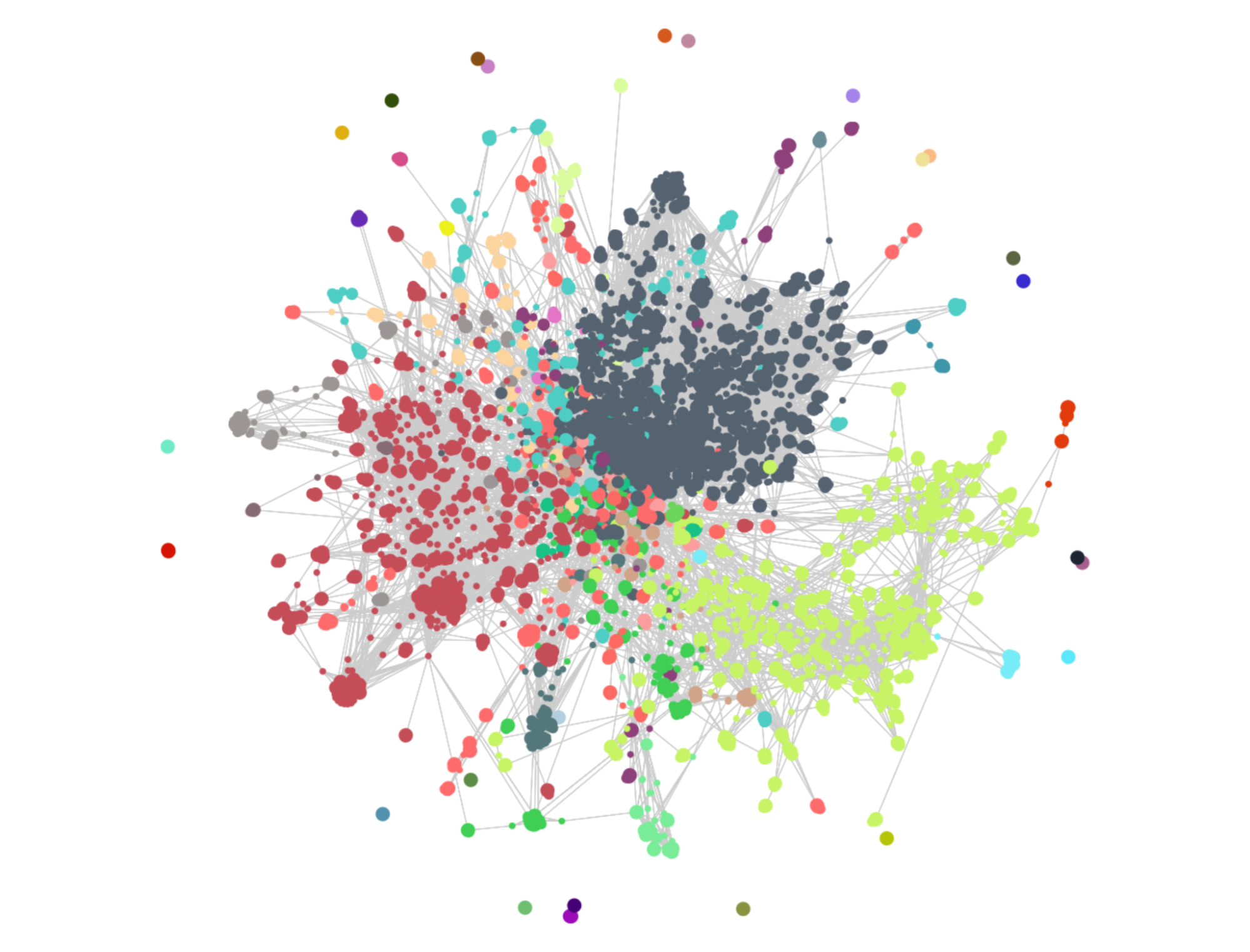
Left: Initial CirclePack layout. Right: ForceAtlas2 spatial layout with Louvain community colors.
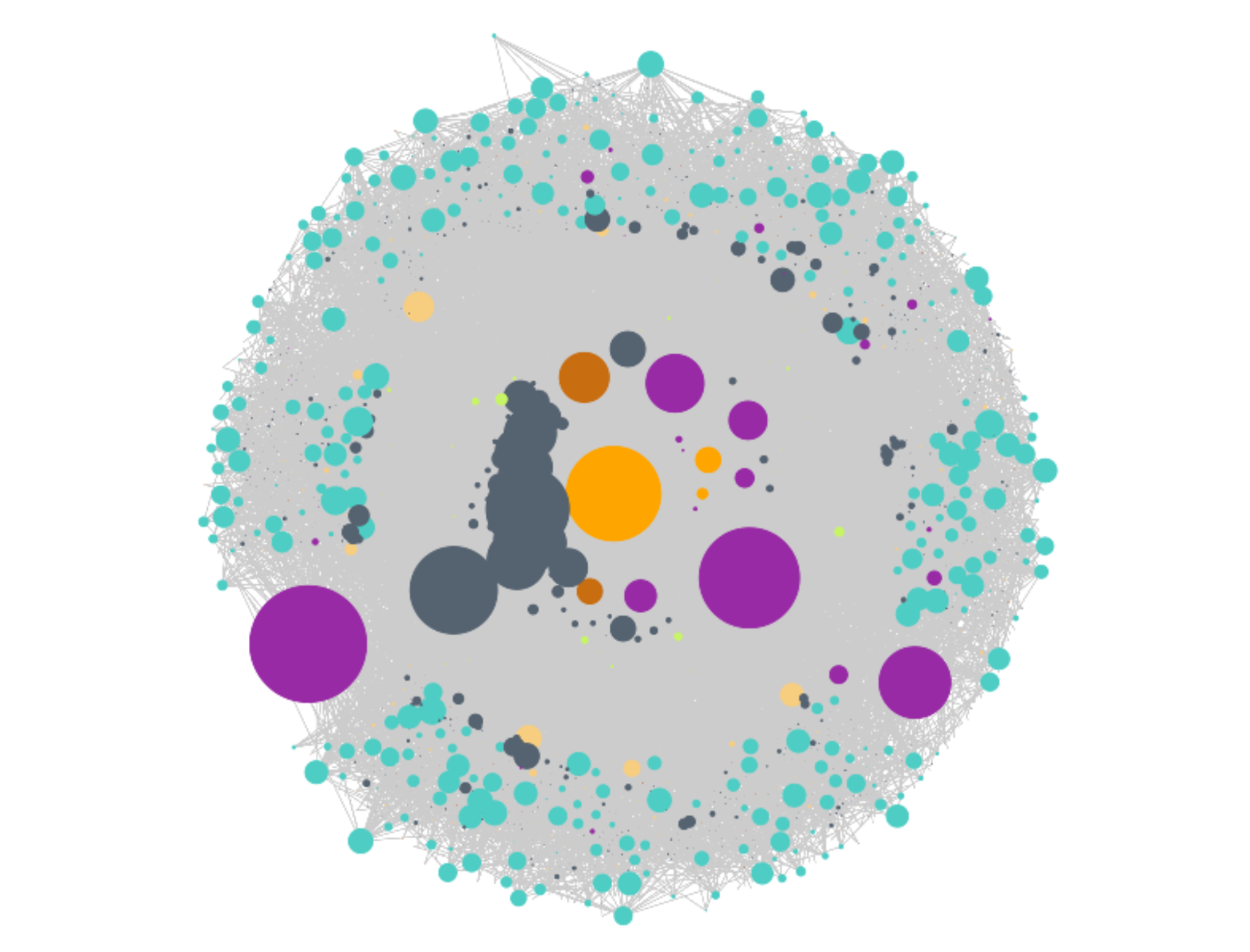
Left: NeighborsNeighbors of #Kosm. Right: Zoomed graffiti subnetwork cluster.
3.3 Node Size by Centrality Metrics
Graphology calculates essential metrics: Degree Centrality (number of connections), Betweenness Centrality (bridge/intermediary nodes), and PageRank. Centrality measures are normalized to maintain comparability across mining depths (depth 0 vs depth 1 & 2).
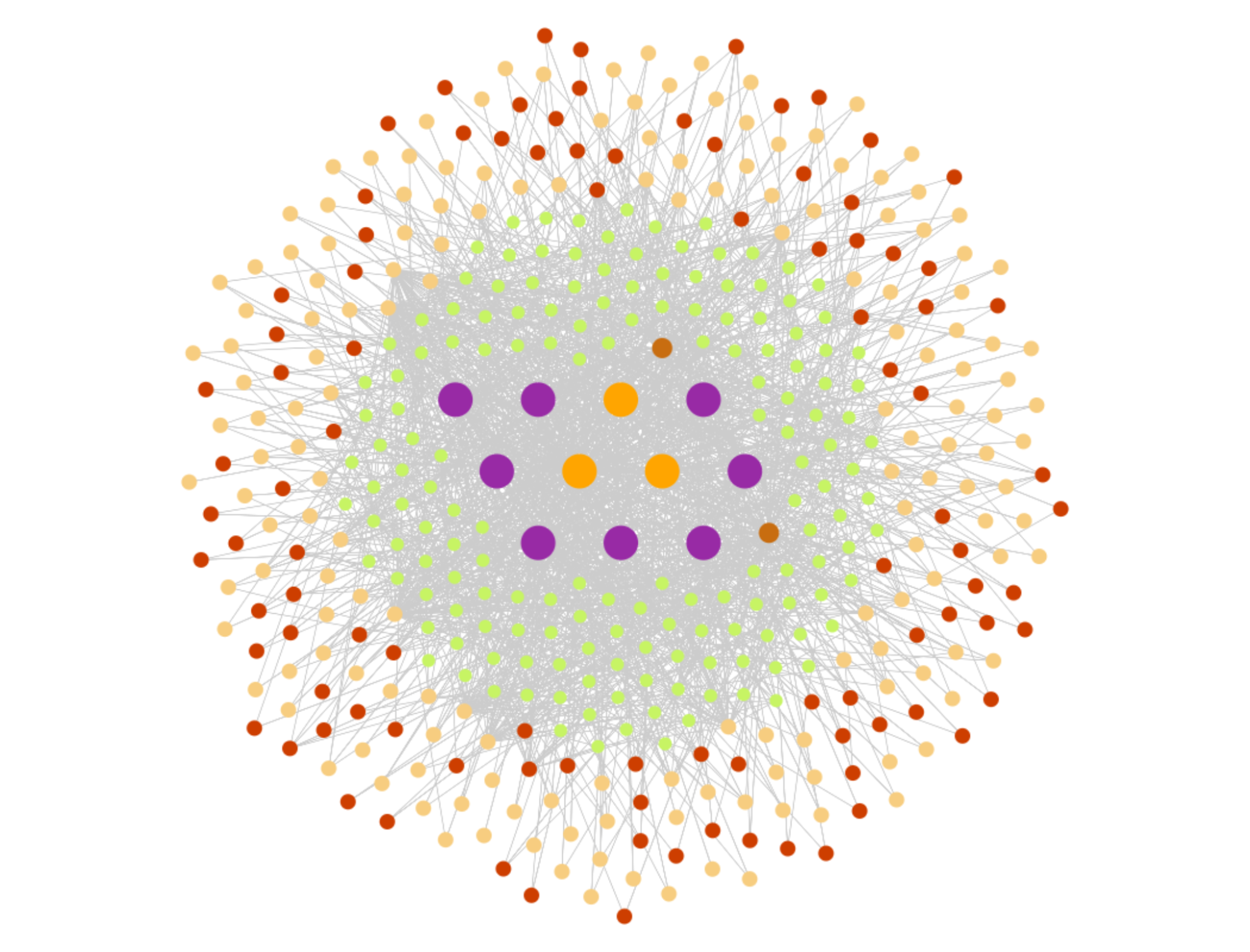
Left: CirclePack layout with fixed node type size. Right: Node size defined by degree centrality.
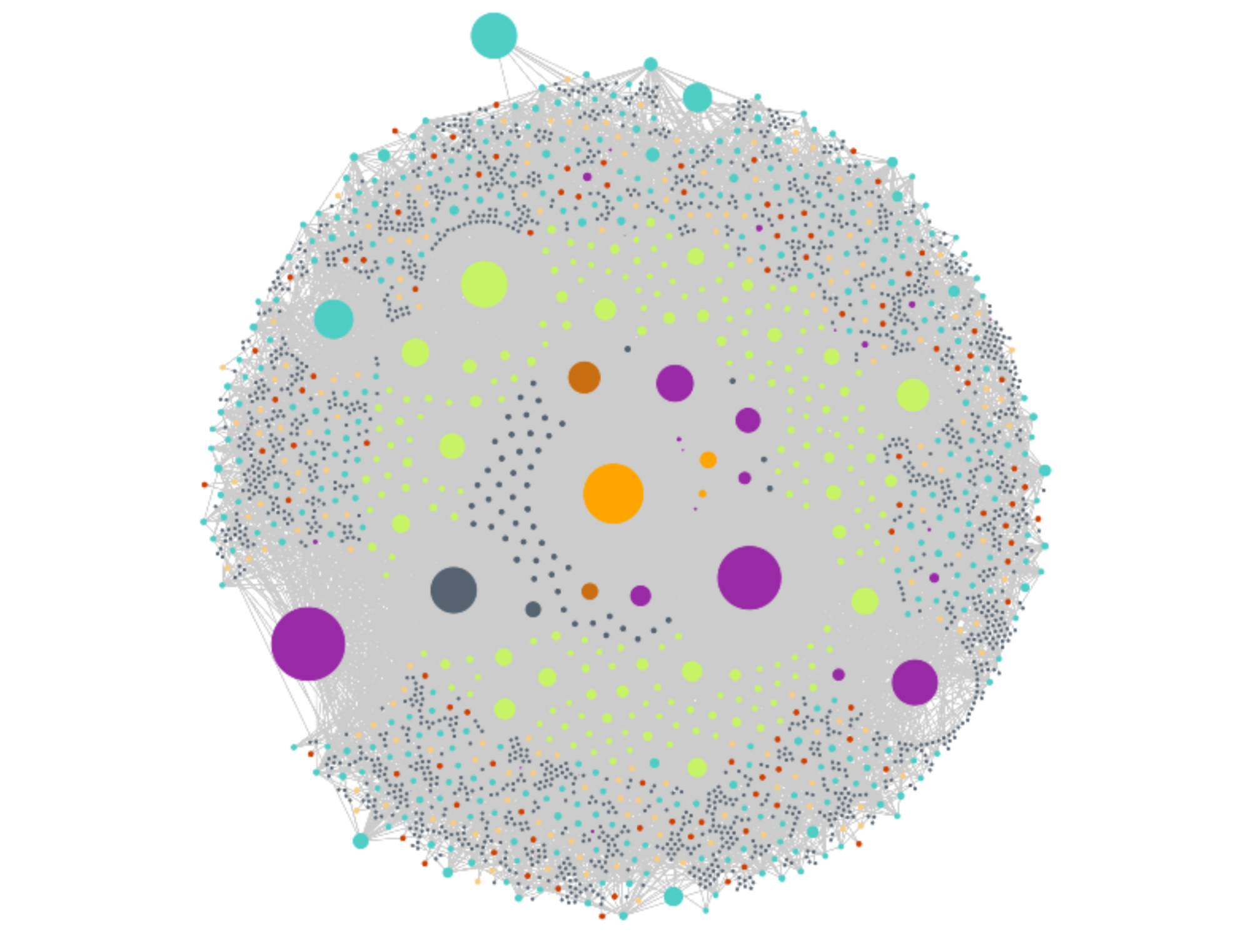
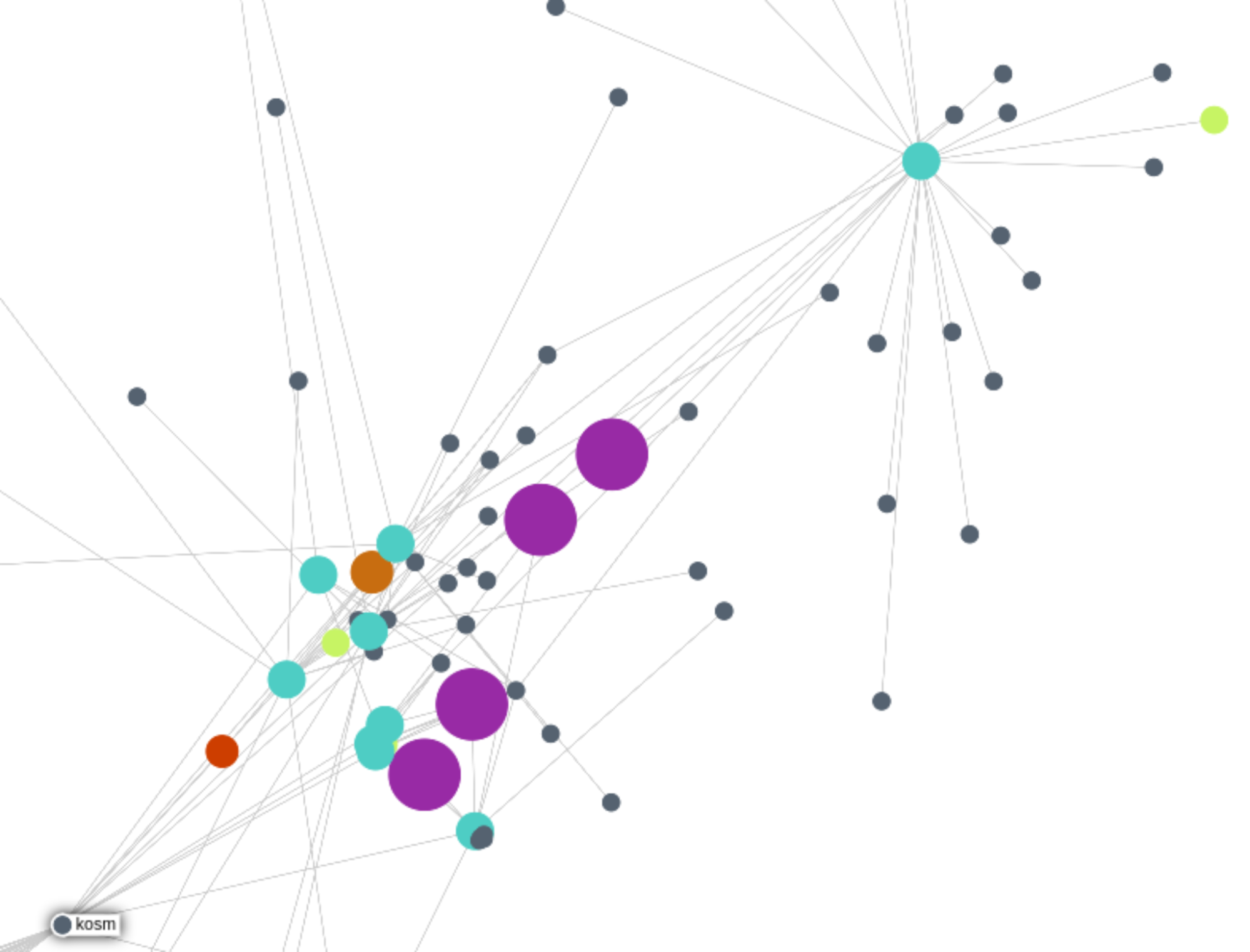
Left: Node size by degree centrality. Right: Node size by betweenness centrality.
4. Node Reduction Filter
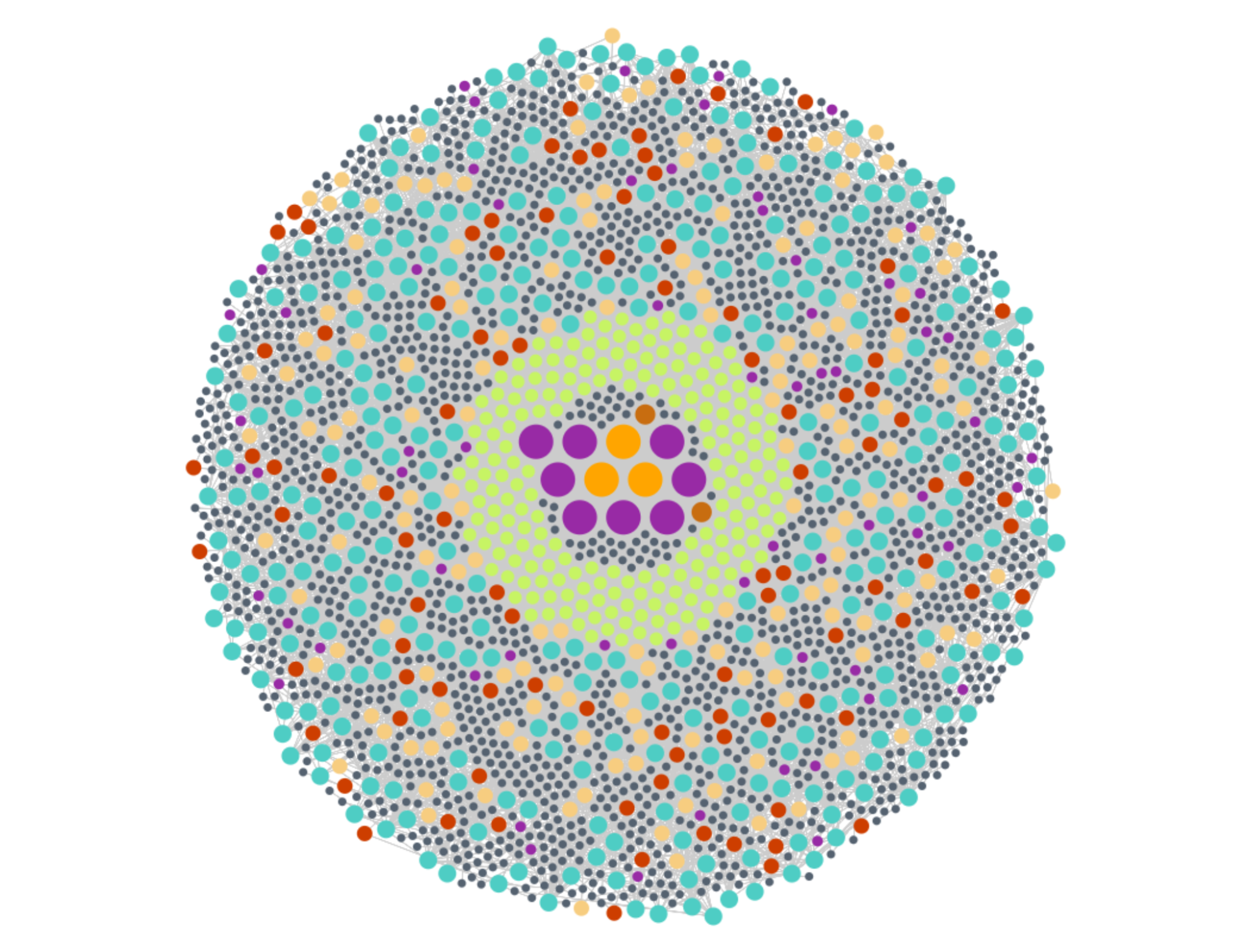
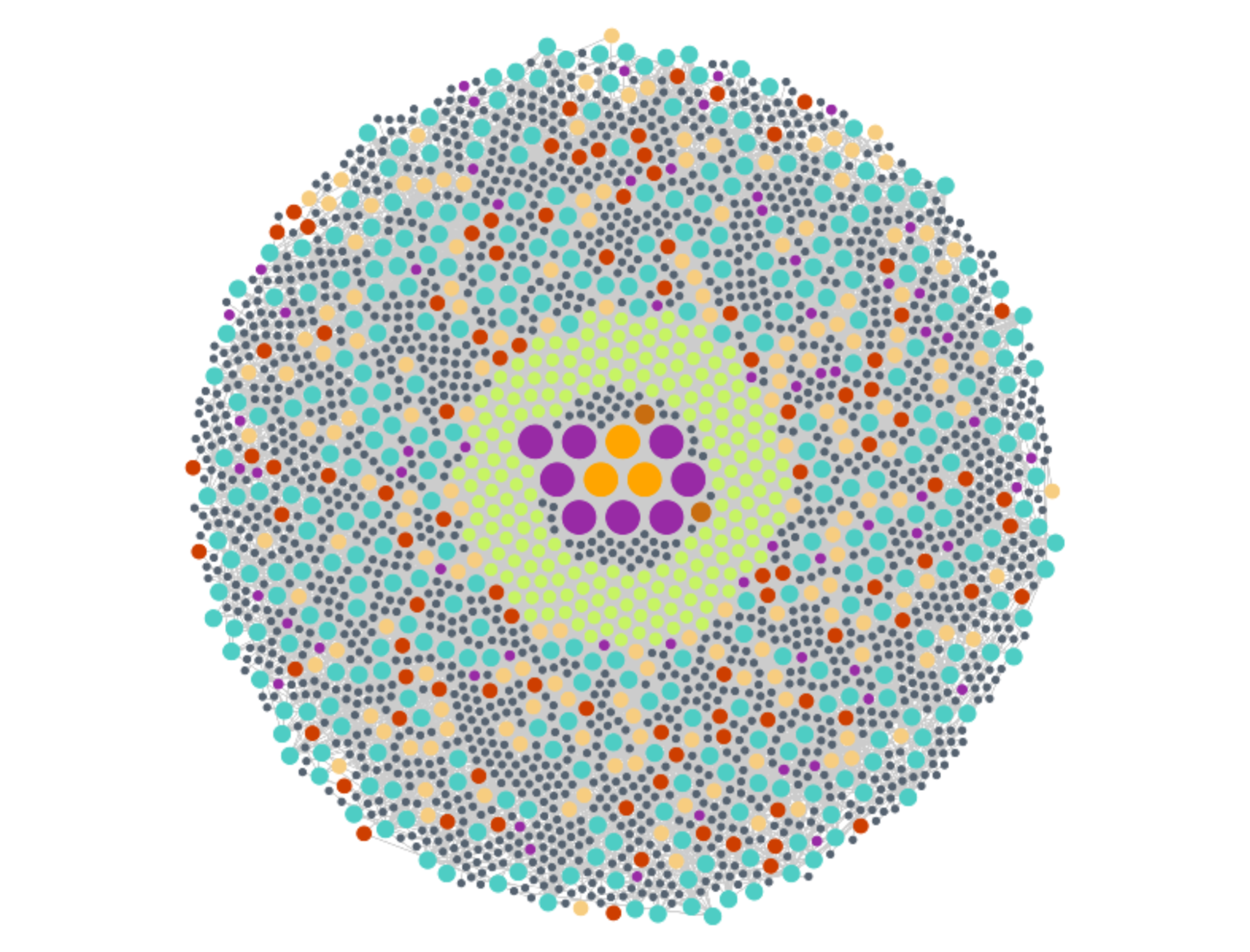
Inference reduction simplifies hyperconnected networks by eliminating intermediate post and hashtag nodes while preserving direct relationships between content authors, Machine Learning image inferences, and dictionary/entity terms.
| Stage | Total Nodes | Posts | Users | Hashtags | Text Words | Entities |
|---|---|---|---|---|---|---|
| Before Inference Reduction | 18,089 | 1,860 | 1,226 | 14,067 | 353 | 412 |
| After Inference Reduction | 1,732 | 0 (Removed) | 954 | 0 (Removed) | 353 | 412 |
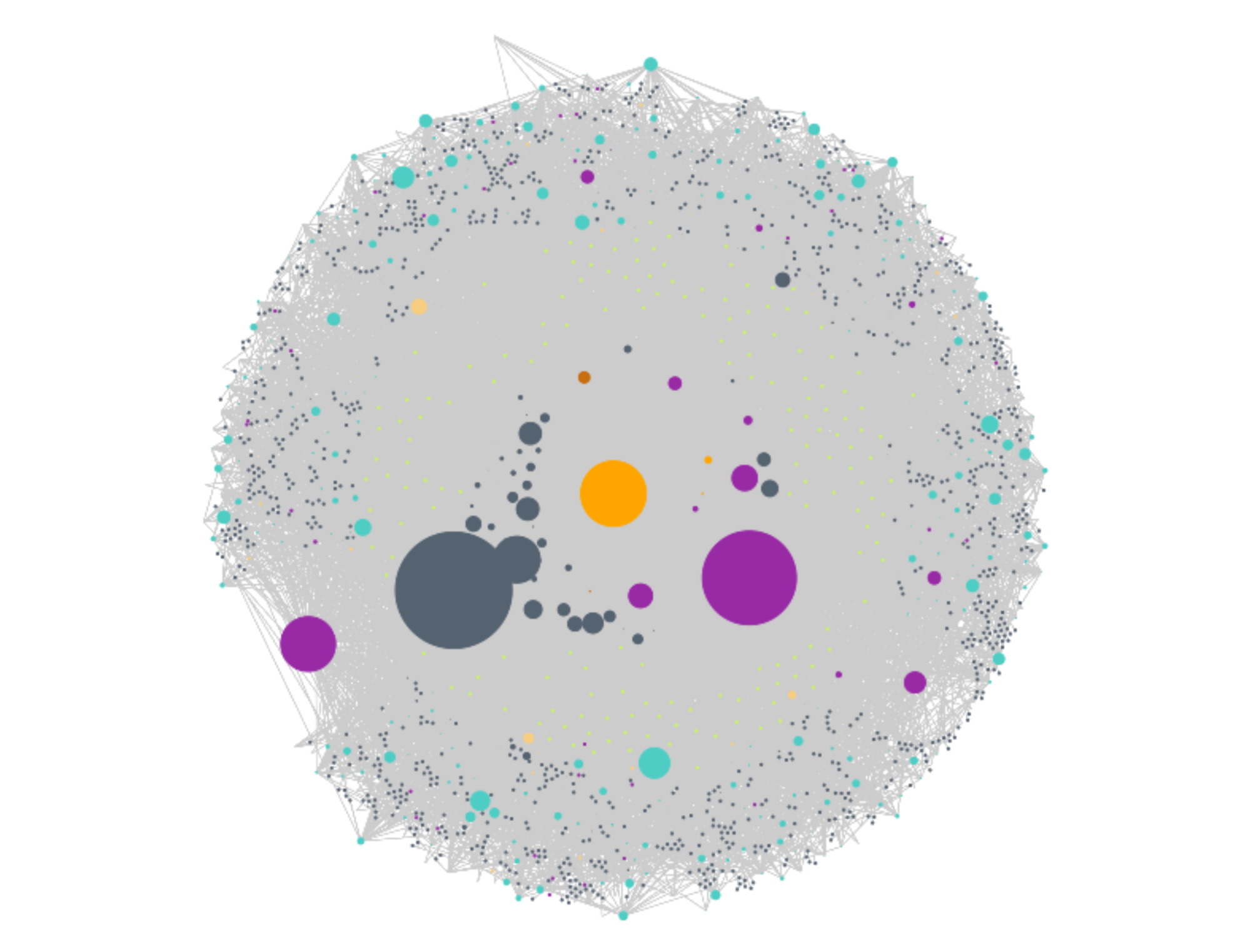
Left: Initial graph with 18,089 nodes. Right: Network after inference reduction (1,732 nodes).
5. Tool Application in Three Examples
The theoretical framework leverages Figueroa's (2014) triadic concept of self-announcement:
🔺 Triad of Self-Announcement (Figueroa, 2014)
- Yo-soy (I am): Self-referential tagging of entities (e.g. “I am Kosm” via
#Kosm). - Yo-existo (I exist): Symbolic community integration through shared glossaries, styles, and hashtags.
- Yo-estuve-aquí (I was here): Conquering physical railcars and digital location tags across geographical nodes.
Communal Meeting Point (>600,000 Posts)
Serves as a mandatory digital gathering space. Node reduction compressed 18,089 initial nodes into 1,732 core nodes, connecting 879 users directly with 257 terms from the graffiti glossary.
Top Writers Identified: Mecri, Trio, Skaf, Powder, Mesy, Kois, Ernst. Crews: KOG, LTS, KGS, SWV, PUC.
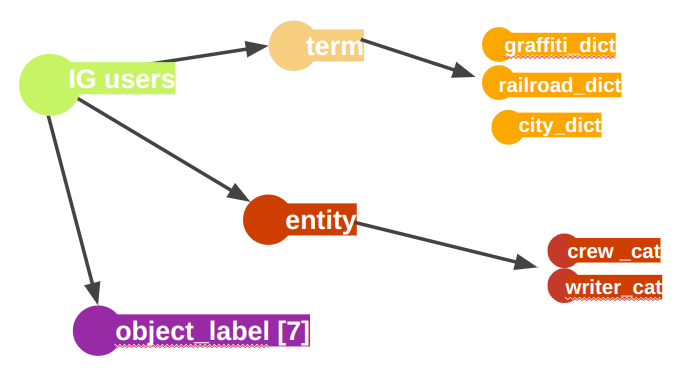
Figure 14: First neighbors of “bomb” term after inference reduction vs before reduction.
Writer Autopromotion & Polysemic Disambiguation
Demonstrates self-promotion (writer tagging own pieces) vs relay-transmission (benchers broadcasting writer pieces as “He-was-here”). Filter reduced initial 510 users to 266 relevant participants.
Top Benched Freight Writers: Ichabod (19 records), Mecro (13), Visah (12), Renik (11), Aser (10).
Geographically Anchored Locality (33 North American Cities)
Examines local benching networks within a broader transnational circuit. Identified 9 key benchers (including @pacificnorthbench, @oddiophoto, @micah_hawaii), 5 graffiti styles, and 26 writer/crew entities (VRS, ATD, 925, CFS).
North American Rail Hubs Mined: Portland, Norfolk, Chicago, Seattle, Minneapolis, Winnipeg, Riverside, Atlanta, Philadelphia, Oakland, Vancouver, Oaxaca.
6. Conclusion
In summary, this paper has shown how computational techniques can help us understand conversations on Instagram, especially among freight train graffiti writers and benchers. We used machine learning and computational methods to back up and actually visualize how freight graffiti writers and benchers interact online. We simplified the network by reducing the number of nodes and links, making it easier to analyze. The process of node reduction has proved instrumental in simplifying the network structure, facilitating closer connections between nodes while enhancing analysis efficiency.
By addressing the challenge of polysemy, exemplified by the case of Kosm, our study has advanced thematic precision within network analysis. This strategic filtering approach ensures that our focus remains on genuinely relevant users and content, contributing to a more refined understanding of community dynamics. After simplifying the network, we found it easier to see connections between users and the symbolic content they share.
7. References
- Abadi, M., Agarwal, A., Barham, P., Brevdo, E., Chen, Z., Citro, C., & Zheng, X. (2015). TensorFlow: Large-Scale Machine Learning on Heterogeneous Systems.
- Adams, A., & Brown, B. (2012). Normalization techniques for network centrality measures. Journal of Network Analysis, 8(3), 123-135.
- Castleman, C. (1980). Getting Up: Subway Graffiti in New York. MIT Press.
- Figueroa, F. (2014). El grafiti de firma: un recorrido histórico-social por el grafiti de ayer y hoy. Minobitia.
- Gomez-Cruz, E. (2022). Technologies of Visibility: Visual Culture and Social Media. Routledge.
- Hepp, A. (2020). Deep Datafication: The Automated Construction of Social Reality. Polity Press.
- Honnibal, M., Montani, I., Van Landeghem, S., & Boyd, A. (2020). spaCy: Industrial-strength Natural Language Processing in Python. doi: 10.5281/zenodo.1212303
- Jacomy, M., Venturini, T., Heymann, S., & Bastian, M. (2014). ForceAtlas2, a Continuous Graph Layout Algorithm for Handy Network Visualization Designed for the Gephi Software. PLoS ONE, 9(6), e98679. doi:10.1371/journal.pone.0098679
- Johnson, R., Smith, T., & Davis, M. (2015). Exploring betweenness centrality in social networks. Social Network Analysis, 15(2), 45-58.
- Moreno, J. (1934). Who Shall Survive? A New Approach to the Problem of Human Interrelations. Nervous and Mental Disease Publishing Co.
- Page, L., & Brin, S. (1998). The PageRank citation ranking: Bringing order to the web. Stanford InfoLab.
- Plique, G. (2021). Graphology, a robust and multipurpose Graph object for JavaScript. Zenodo. doi:10.5281/zenodo.5681257
- Smith, J., & Jones, R. (2010). Understanding degree centrality in network analysis. Journal of Computational Sociology, 5(1), 32-45.